Why the Porsche 911 Dakar Makes More Sense Than It Should

– 2 min read



A Porsche 911 raised off the ground, fitted with all-terrain tyres and designed to travel across loose surfaces sounds like the answer to a question nobody asked.
That is part of its appeal.
The 911 has spent decades becoming increasingly precise. The Dakar takes that precision and deliberately introduces dirt.
A sports car that stopped taking the road seriously
The Dakar uses the basic architecture of the 911 but changes its relationship with the surface underneath it.
Its twin-turbo flat-six produces 480 PS and sends power through an eight-speed PDK to all four wheels. More importantly, the car sits significantly higher than a conventional 911, uses all-terrain tyres and can raise itself further when required. Porsche lists ground clearance of 161 mm in its normal setting and 191 mm in the raised position.
Those numbers turn something familiar into something strangely versatile.
The Dakar is still capable of accelerating from zero to 100 km/h in 3.4 seconds, yet its top speed is deliberately limited to 240 km/h because of the tyres.
For a 911, that almost feels like a philosophical statement.
Maximum speed is no longer the point.
Performance without the perfect road
Most modern sports cars require ideal conditions to reveal what they can do.
Smooth asphalt, wide roads and increasingly high speeds are needed before their engineering begins to feel challenged. That can make them extraordinary machines but slightly frustrating road cars.
The Dakar changes the question.
Instead of asking how fast a 911 can travel on perfect asphalt, it asks how much fun the car can remain when the road becomes imperfect.
Loose gravel, snow, broken surfaces and dirt suddenly become part of the experience rather than something to avoid.
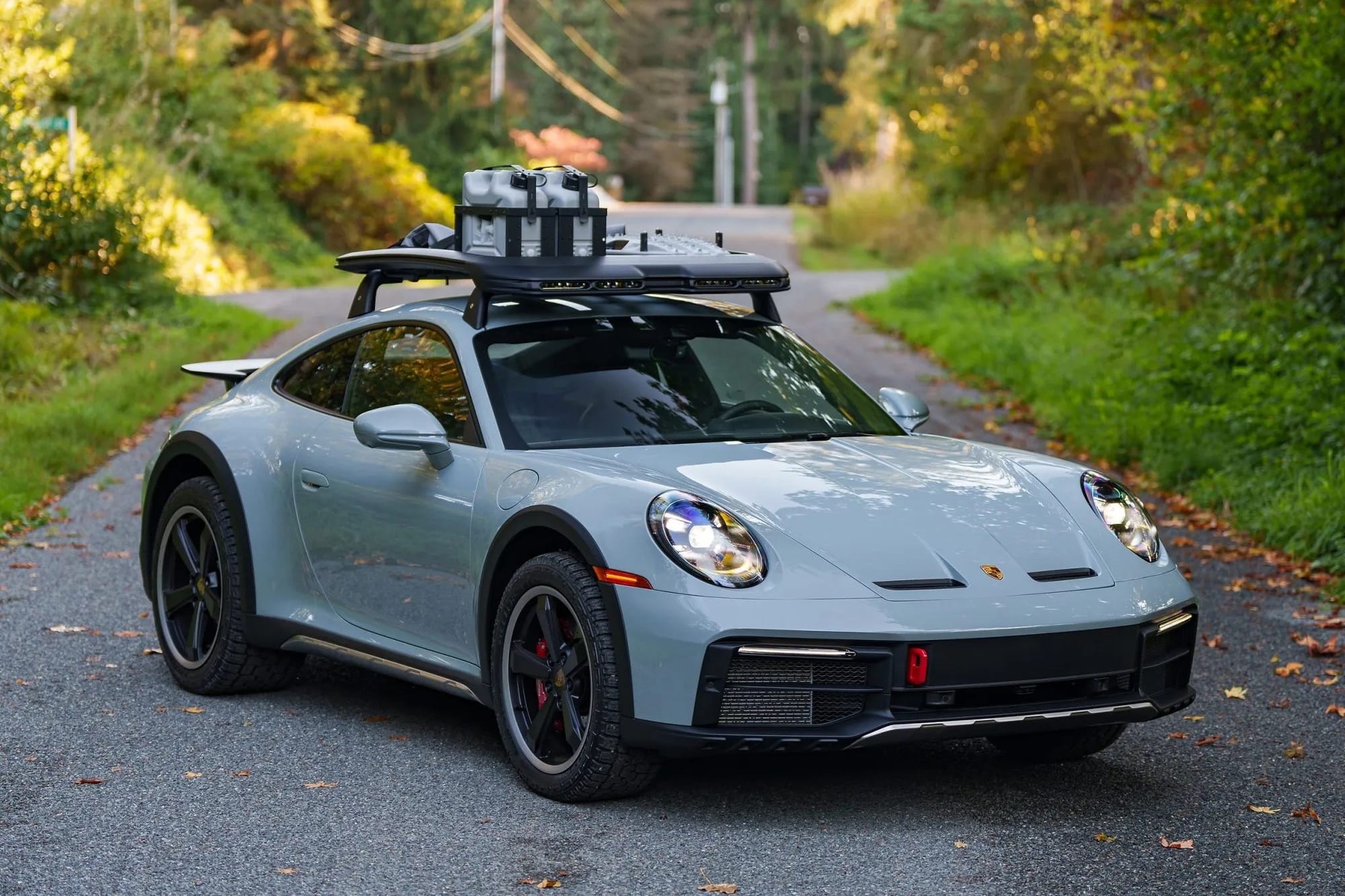
This explains why the car makes more emotional sense than its specification initially suggests.
It broadens the number of situations in which the driver can interact with the car without requiring extreme speed.
The luxury of not being precious
There is also something refreshing about an expensive sports car that seems to invite dirt.
Luxury cars are traditionally protected. Paint is polished, wheels are watched carefully and owners learn to avoid narrow parking spaces and bad roads.
The Dakar encourages almost the opposite behaviour.
Porsche modified cooling and filtration systems specifically for environments with more dust and slower off-road driving. The engineering is there so that using the car beyond perfect asphalt does not feel like misuse.
That creates a different relationship with the object.
A scratch may still hurt, but the car no longer looks as though its natural habitat is a climate-controlled garage.
Perhaps this is what an exotic car should do
The 911 Dakar is objectively unnecessary.
That does not make it irrational.
Luxury products rarely become interesting because they satisfy basic needs efficiently. They become interesting when they create experiences that ordinary objects cannot.
The Dakar turns one of the world's most familiar sports cars into something less predictable.
It sacrifices some theoretical road performance in exchange for greater freedom about where the road can go.
That sounds strange until you realise freedom was probably the luxury all along.